


Creditworthiness Is the Next Collateral

Crypto is a liability-engineering technology, not an asset-underwriting technology. Its most successful exports have all been liabilities: a stablecoin is a claim on a dollar, a liquid staking token a claim on staked ETH, a synthetic dollar like USDe a claim on a hedged basis position. Credit scoring belongs in the same tradition. In order to reach internet scale, it has to price liabilities, not assets.
Every era of DeFi has been defined by what it accepts as collateral, and each one opened up a new kind of economic activity.
(a) BTC and ETH. MakerDAO turned ETH into the first decentralized dollar, and Aave and Compound turned every major token into borrowing power without having to sell it. Overcollateralized lending produced the first onchain money markets and the first onchain leverage, with no counterparty to trust.
(b) Yield-bearing stables. Abracadabra, for instance, minted $MIM against interest-bearing vault tokens. Ethena and Pendle took it mainstream, and sUSDe and PT loops on Aave and Morpho grew into a multi-billion dollar carry trade. Collateral started earning yield while it secured a loan, and Pendle turned that yield into tradable fixed and floating legs, effectively DeFi's own interest rate swap market.
(c) Creditworthiness. A promise backed by creditworthiness needs only a fraction of its size posted as margin, and the rest of the capital stays wherever it already is until it's called, whether that is a fund's balance sheet, BTC on an exchange or dollars in a bank. That opens DeFi up to capital it has never been able to reach.
The first two removed the need for trust when you borrow. The third will make trust itself something you can post as collateral.
Credit scores are +$1T economic infrastructure
Credit scores make it possible to turn future income into present investment at massive scale, across an entire economy. Households buy homes decades before they could have saved for one, families finance cars, and small businesses get credit lines, each priced to the risk of the borrower. Countries that share credit information lend more to their private sectors, and their credit grows faster once they start. Deeper credit markets, in turn, are one of the more reliable predictors of faster economic growth, capital formation and productivity.
Mechanically, a score lets a lender price the risk of someone it has never met, and the surplus from pricing it well is shared between them. The lender earns on risk it would otherwise have turned away, and a good borrower pays less than the average borrower.
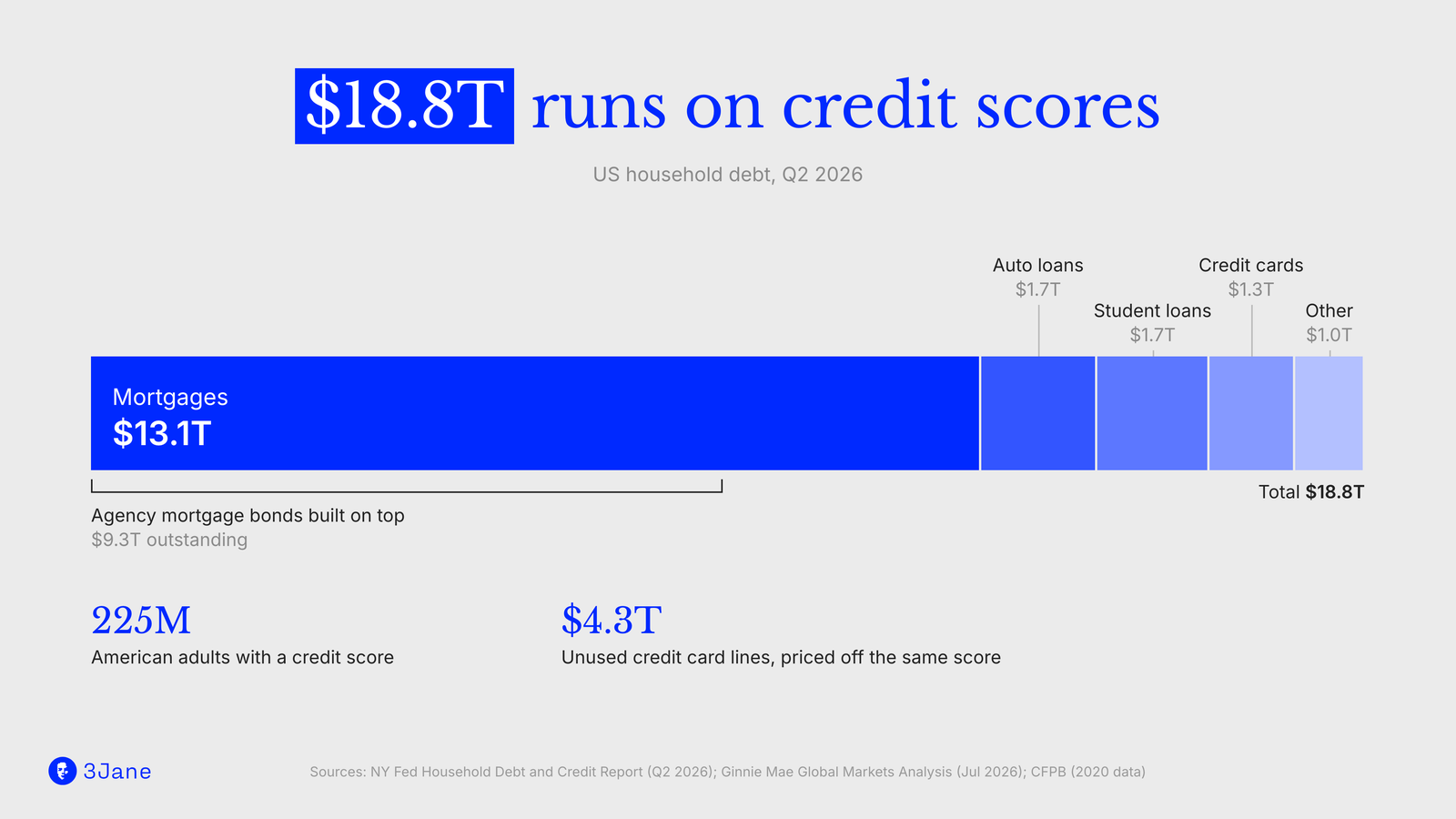
In the US, credit scores underpin $18.8T of household debt, including the $13.1T of mortgages behind a 65% homeownership rate, $1.7T of auto loans and $1.3T of credit cards. ~225M American adults have a score, nearly every major lender prices off of one, and the $9.3T agency mortgage-bond market is built on top of them.
It is no wonder, then, that crypto has tried to build its own version many times over. Every attempt so far has either failed or remains subscale.
One way to reason about why is to think of a scoring system as a network that everyone wants to join and keep cooperating with over decades. That only happens when the product it prices does three things at once.
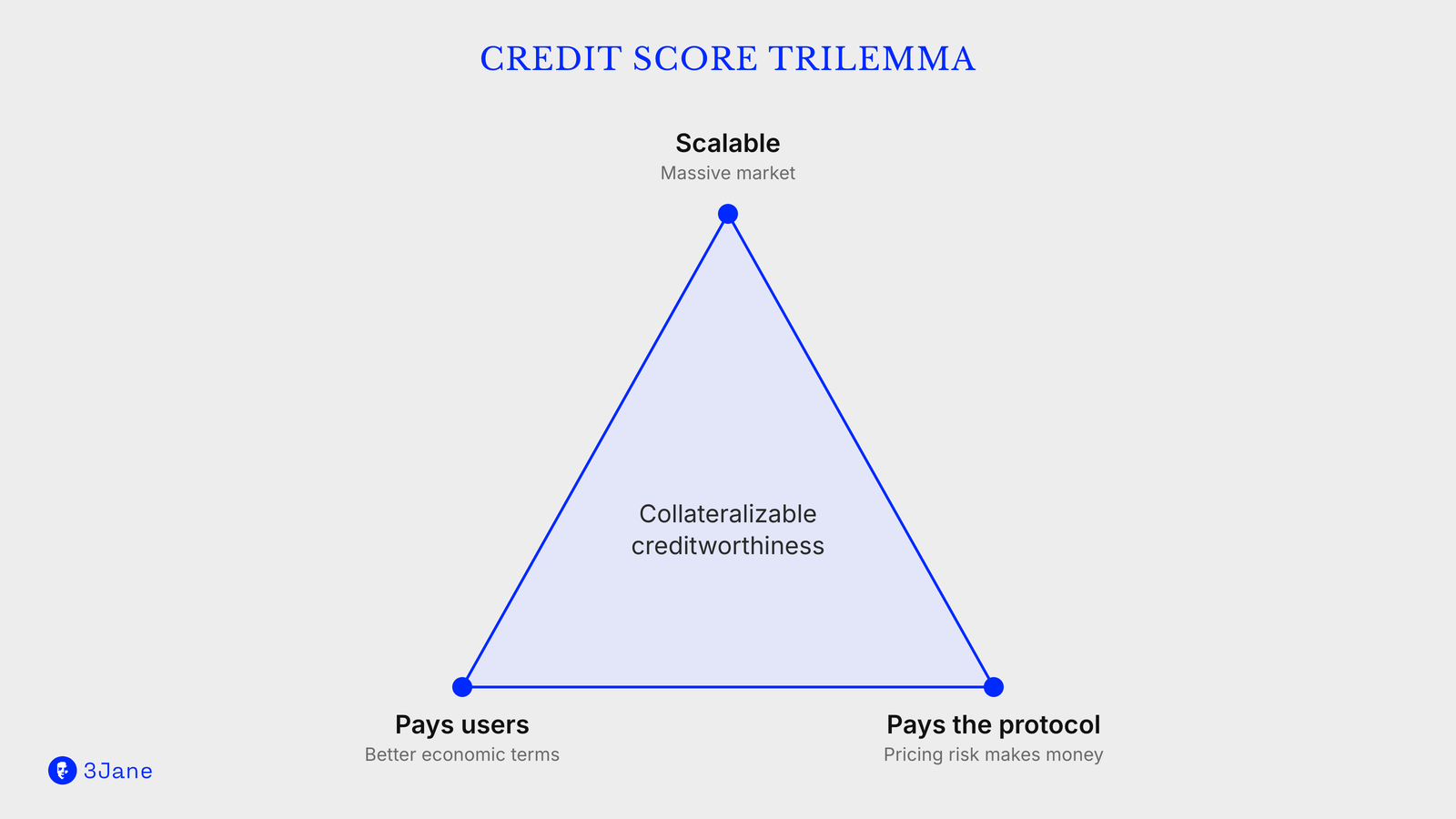
- Scalable: a market big enough to reach critical mass.
- Pays users: a good record earns better economic terms.
- Pays the protocol: pricing risk makes the lender money.
FICO points at traditional consumer credit, and traditional consumer credit does all three. It operates at enormous scale, it saves good borrowers money through lower rates, and it lets lenders profitably serve a far larger market. All three rely on recourse through collections, the courts and the house itself.
Crypto-native credit scores have mostly been pointed at two things:
(a) Retail unsecured lending. This was where everyone started, since it's what credit scores were built for. Borrowers benefited because they could access credit without posting collateral, and lenders arguably benefited from pricing risk a little better at the margin, but it never scaled. Without collateral, legal recourse or a persistent identity, strategic default is rational: keep the money, abandon the wallet, lose only future access. The game theory has been discussed ad nauseam. Lenders had to gate who could borrow and cap how much, or go bankrupt. BTCJam graded peer-to-peer bitcoin borrowers from 2012 and shut down in 2017; RociFi lent to anonymous wallets against an onchain score in 2022. Over a decade, retail-facing crypto lenders originated less than $50M, less than a mid-tier BNPL lender does in a month (read more).
(b) Social reputation. Scores used for social purposes, such as proving you're human, signaling credibility or vouching for someone, and built from attestations, vouches and onchain history, as with Gitcoin Passport, DegenScore or Ethos. You could argue it scales. However, it doesn't pay users or protocols. There are second-order effects, like airdrop allowlists, or getting shamed on CT and making your Nth rug dead on arrival, but there is no direct payoff or feedback loop that makes money for the broader market. People want to make money.
No product built on crypto credit scores has managed to scale, pay users and pay the protocol at once. The moment one does, a score gains value on top of its scarcity and becomes a financial primitive, usable as collateral across DeFi at global scale. It would combine the best of DeFi with the capital efficiency of traditional finance. To find that product, you have to look at the liability side of the balance sheet, not the asset side.
Promises
Most DeFi credit underwriting asks whether a borrower will return capital. A promise asks whether a capital provider will deliver it in the future.
A promise is an assurance that someone will or won't do something in the future. In finance it usually goes by capital commitment: a promise to provide capital later, once some trigger is hit. Commitments exist because transactions need certainty before they need cash. A company draws on its revolver when it needs working capital, a warehouse facility funds when an eligible loan is ready, a fund calls LP capital when a deal closes, and a standby letter of credit pays only if a covered payment is missed. In each case the certainty is needed today, while the cash may not be needed for months, or ever.
A credible promise is something another person can plan around, another market can price and another institution can build on. It makes a future balance sheet usable today.
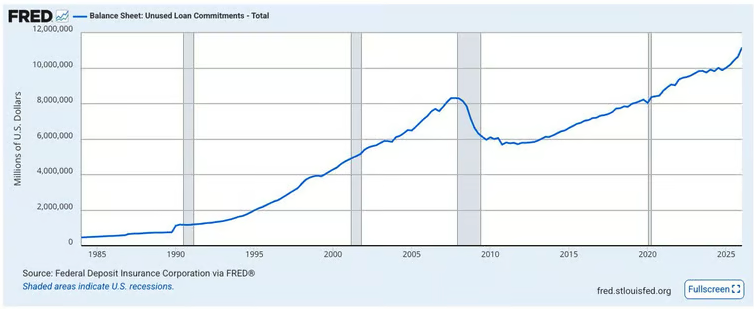
Banks sell promises at enormous scale. US banks carry $11.3T of unused loan commitments.
The same structure is common in the AI buildout. Nvidia has promised to buy up to $6.3B of CoreWeave's unsold cloud capacity through 2032, and banks committed $3.6B of delayed-draw financing to IREN for its Microsoft contract. In both cases the commitment is unfunded and highly capital efficient, and the capital only moves around once it's needed. Private markets work the same way: LPs commit to a fund and the GP calls capital as deals close, and roughly $4T of private capital sat committed but uncalled as of March 2025.
3Jane has the same problem. We have a +$200M pipeline of warehouse and forward-flow facilities, and each one draws capital as fintech lenders originate loans. Holding all of it as idle cash in advance would be extremely wasteful and unviable in the long term for a number of reasons, so 3Jane buys promises instead: capital that stays with its owner until a facility needs it, then gets called into USD3. Capital providers continue to earn on their capital until it is called, while 3Jane can rely on it being available when a facility draws.
Levered Callable Capital (LCC) is the mechanism through which 3Jane sources these promises.
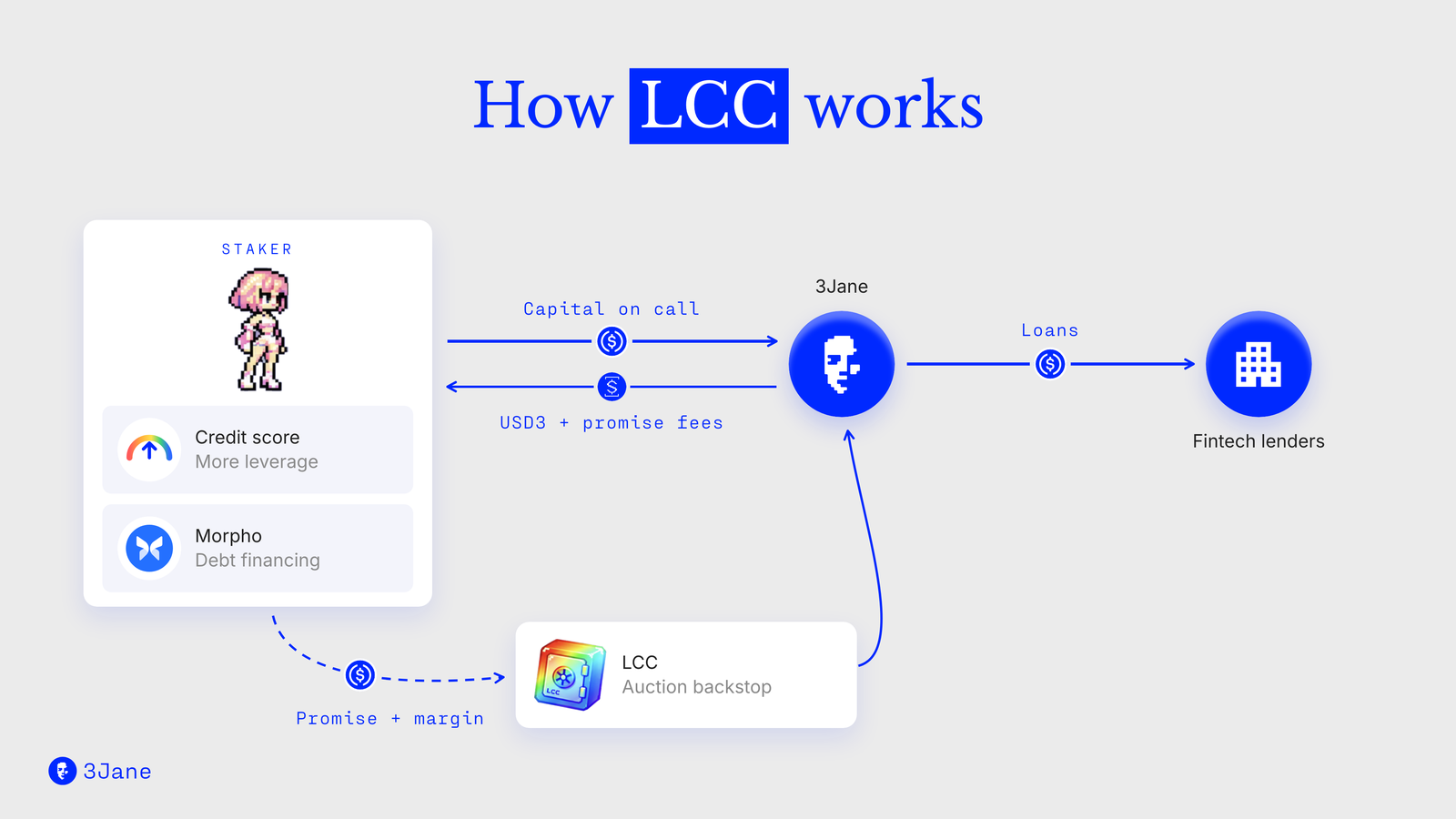
- Stakers promise capital that stays with them until it's called. They post a fraction as margin and earn promise fees on the full amount.
- 3Jane calls the capital when a fintech lender needs it or a new facility goes live, and stakers receive USD3.
- LCC holds the margin. If a staker misses a call, the auction pays someone else to fund it.
- Credit scores will set how much each staker can promise per dollar of margin, alongside other benefits such as up to 5x higher promise APY, higher promise caps and boosted $JANE emissions.
- Morpho lets stakers fund a call with debt against the USD3 it delivers, so they can make much larger promises, up to 6.25x their net worth.
The scores come from Cred Protocol, which reads an address's public onchain history, including lending, repayments, liquidations, LP positions, staking and wallet age, and scores it from 300 to 1,000. Any address or ENS name can be looked up on the LCC page.
LCC sits alongside the traditional capital calls 3Jane runs with its LPs rather than replacing them.
Because the commitment is unfunded, a promise delivers significant capital efficiency at the cost of counterparty risk, since 3Jane relies on each staker to deliver capital it does not hold. Pricing that counterparty risk is precisely what credit scores were built to do, which makes promises an ideal use case for them.
Promises are the killer use case for credit scores
Unlike a loan, a promise involves no capital changing hands until it is called, so a missed call is a funding problem rather than a credit loss, and the margin and the auction exist to get it funded by someone else. As a result, promises satisfy all three conditions of the trilemma:
- Scalable: anyone with an address can make a promise, including retail users and pseudonymous credit funds, so it can operate at internet scale.
- Pays users: stronger creditworthiness will earn more leverage and higher caps, so the same capital backs a bigger promise and earns more promise fees.
- Pays the protocol: reliable promises need less margin and less auction capacity behind them. 3Jane can pay less per dollar promised while stakers earn more on what they post, the same split a credit score creates between a lender and a good borrower. And because capital doesn't move until it's called, it can sit anywhere, so the pool of capital that can back a promise is far larger than what sits in DeFi today.
LCC is heavily undercollateralized by design. A staker posts $7.50 of margin against every $100 promised, and that capital efficiency carries real risk, since a staker may fail to fund a call and the auction may not fully replace them.
Before LCC, credit scores tried to make undercollateralized lending safe. In LCC, margin and auctions make undercollateralized promises workable, and credit scores make them far more capital efficient.
Promises sit between overcollateralization and unsecured credit
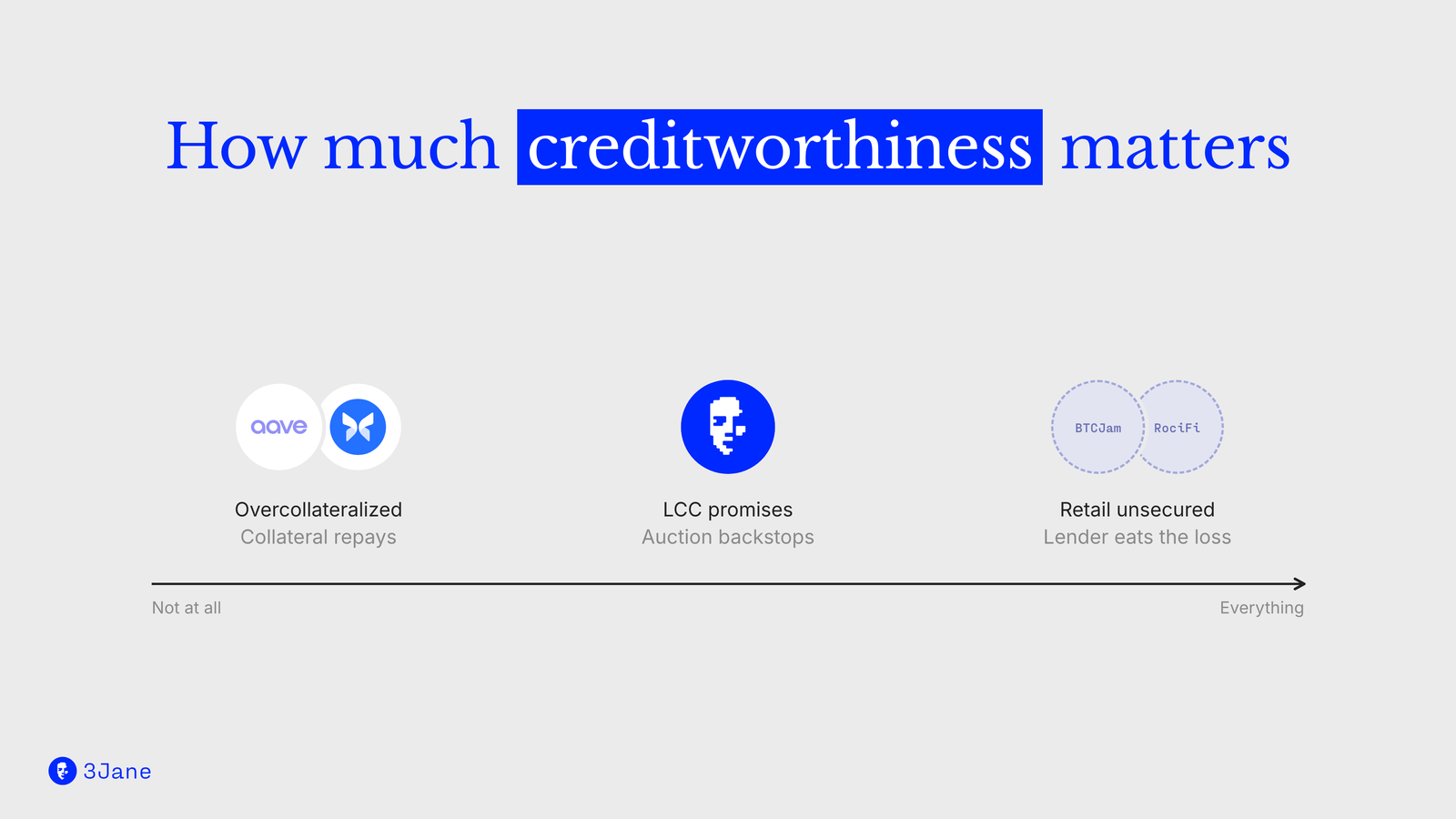
In overcollateralized lending, the protocol already holds an asset that can repay the obligation. A liquidator sells it, and the borrower's cooperation does not matter at all.
In unsecured credit, the borrower's creditworthiness is the only thing standing behind the loan, and if the lender misjudges it, the principal is lost.
LCC sits in between. The protocol holds a performance bond rather than the capital. Completing a missed call still takes someone willing to supply fresh capital and hold USD3, with its duration and credit risk. Replacing a promise is far more demanding than selling collateral atomically. Any liquidation bot can sell collateral into a deep market in a single transaction, whereas a missed call relies on a much smaller universe of capital willing to step in, fund it and hold the resulting USD3. Creditworthiness therefore matters far more than in overcollateralized lending, without the pool depending on it the way unsecured credit does.
Margin and the auction are enough to make promises safe. Credit scores determine how efficiently, and how widely, they can scale.
Creditworthiness
For something to serve as collateral, forfeiting it must represent a meaningful economic loss. Creditworthiness in LCC meets that standard on three counts:
- Its value lies in future earnings. A lower Cred Score will reduce the leverage, caps and fees available on every subsequent promise. The benefit of missing a single call, whether liquidity retained or a loss avoided, is small relative to the profits from honoring promises over many rounds.
- It is scarce. A wallet can be created in seconds, whereas a history of honoring promises accumulates only over time.
- Its failure is contained. A staker who acts irrationally cannot bankrupt the protocol. No capital was lent to them, their margin compensates whoever funds the call in their place, and 3Jane's traditional LP capital calls sit behind both.
In LCC, creditworthiness will pay in two ways:
- Lower margin. Every staker posts the same 7.5% margin today. Stronger creditworthiness will need less, so the same margin opens a bigger promise and earns fees on more of it.
- Higher caps. How much an address can promise will grow with its creditworthiness, not just its wallet.
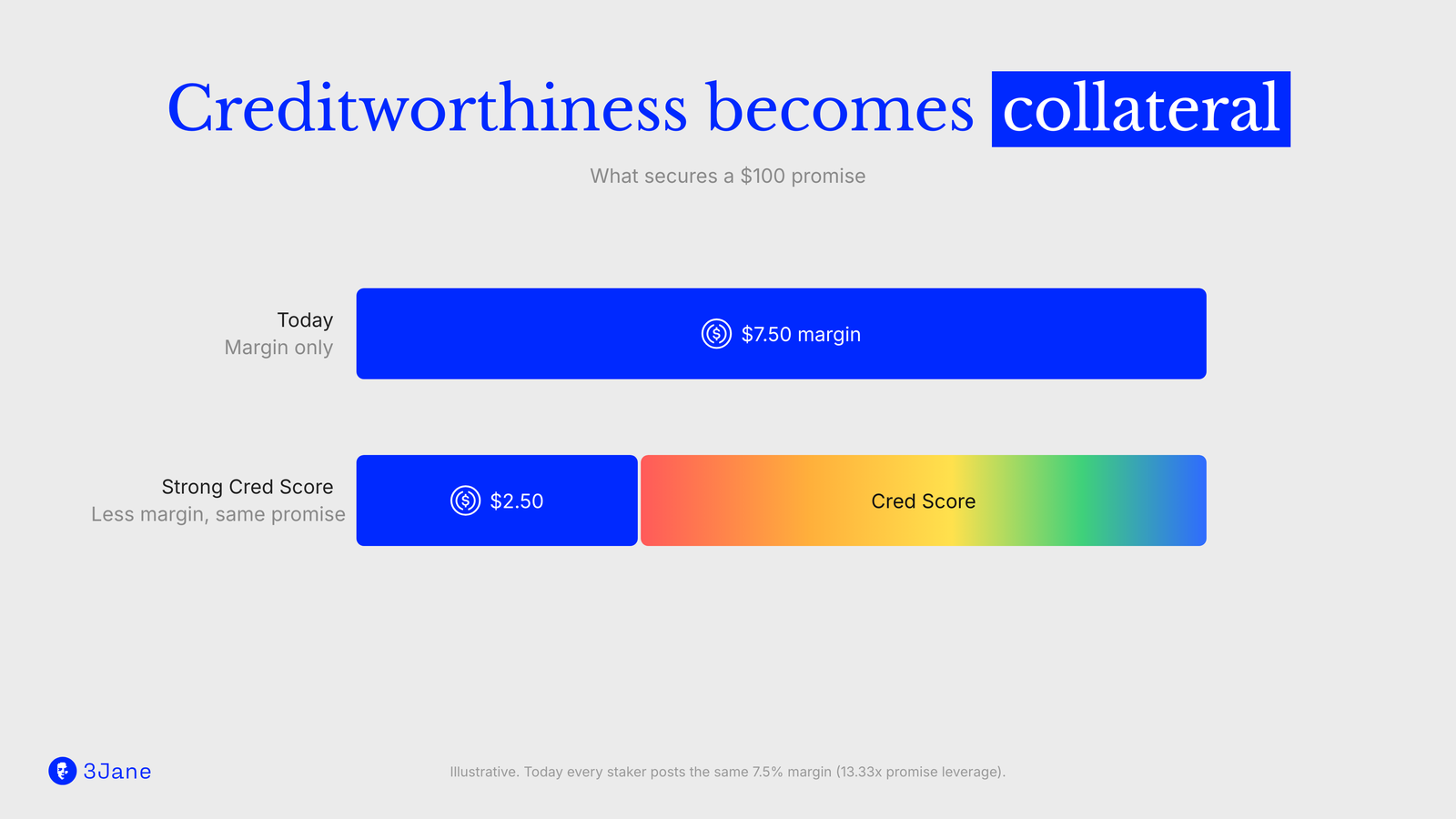
Today, every staker secures a $100 promise with the same $7.50 of margin, regardless of their history. Once Cred Scores feed into terms, a staker with a strong score will be able to secure the same promise with less margin, with the score covering the difference. The margin they no longer need can then back a larger promise and earn fees on more of it. The figures above are illustrative.
Margin, caps and the auction protect the pool while the score is still learning, so new addresses will start on conservative terms and earn better ones as they fund calls. We are integrating with Cred Protocol so that capital calls feed directly into the score, with successful calls raising an address's Cred Score and failed calls lowering it. This gives the score a direct record of whether an address delivers capital when called, which no wallet-history signal can provide on its own.
A missed call already costs part of your margin, and unlike a default on an unsecured loan, it pays nothing, since there is no principal to run off with.
Retail unsecured lending had the incentives the other way around, since creditworthiness paid very little and a default paid out the whole principal.
Once it is both valuable and costly to lose, creditworthiness can serve as collateral in its own right, alongside BTC, ETH and stablecoins.
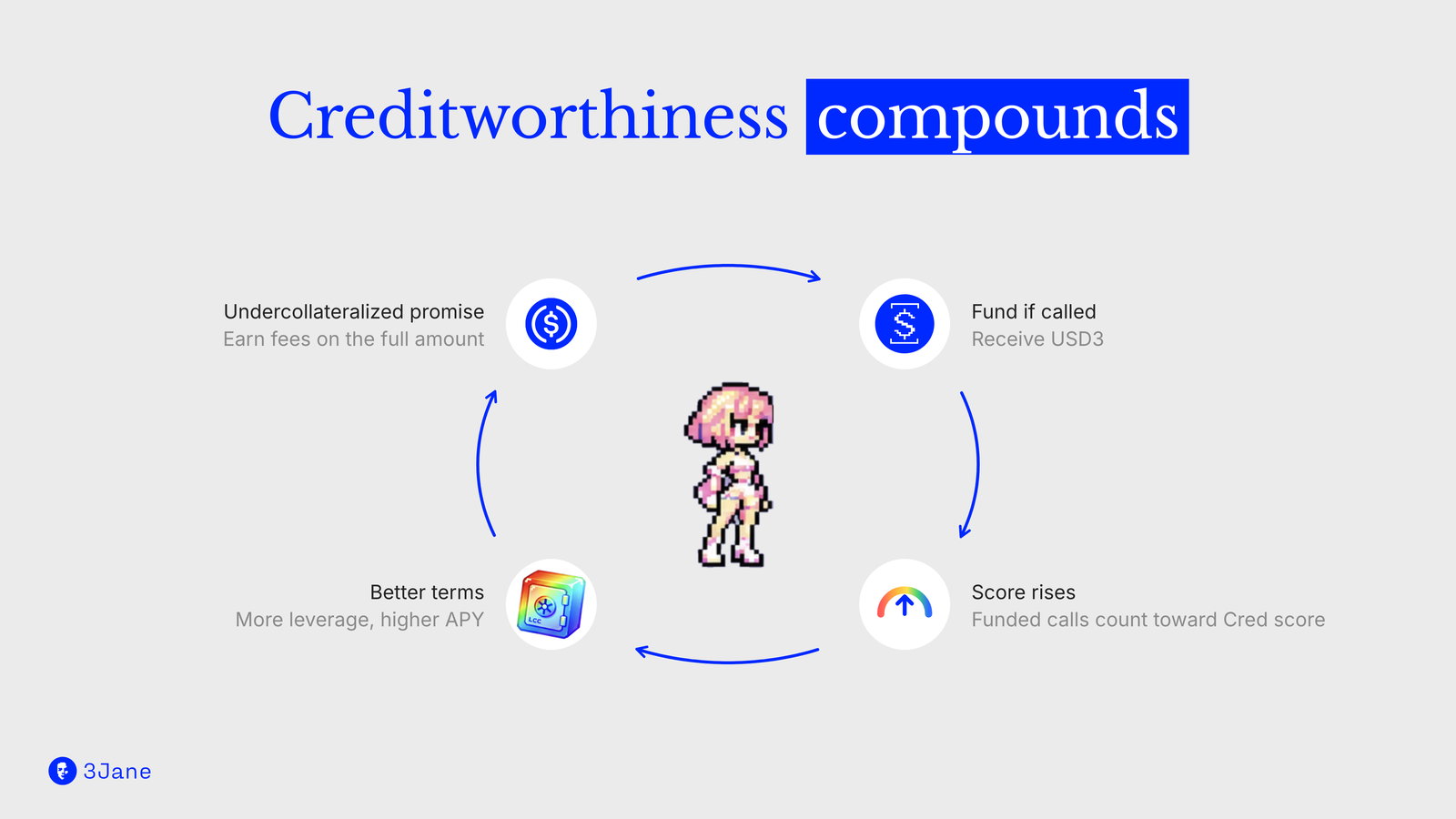
Creditworthiness matters enough to reward, and mistakes don't destroy the pool. This creates an environment with all the preconditions for a credit score to become economically useful.
$10.9M promised, $45.7M behind it
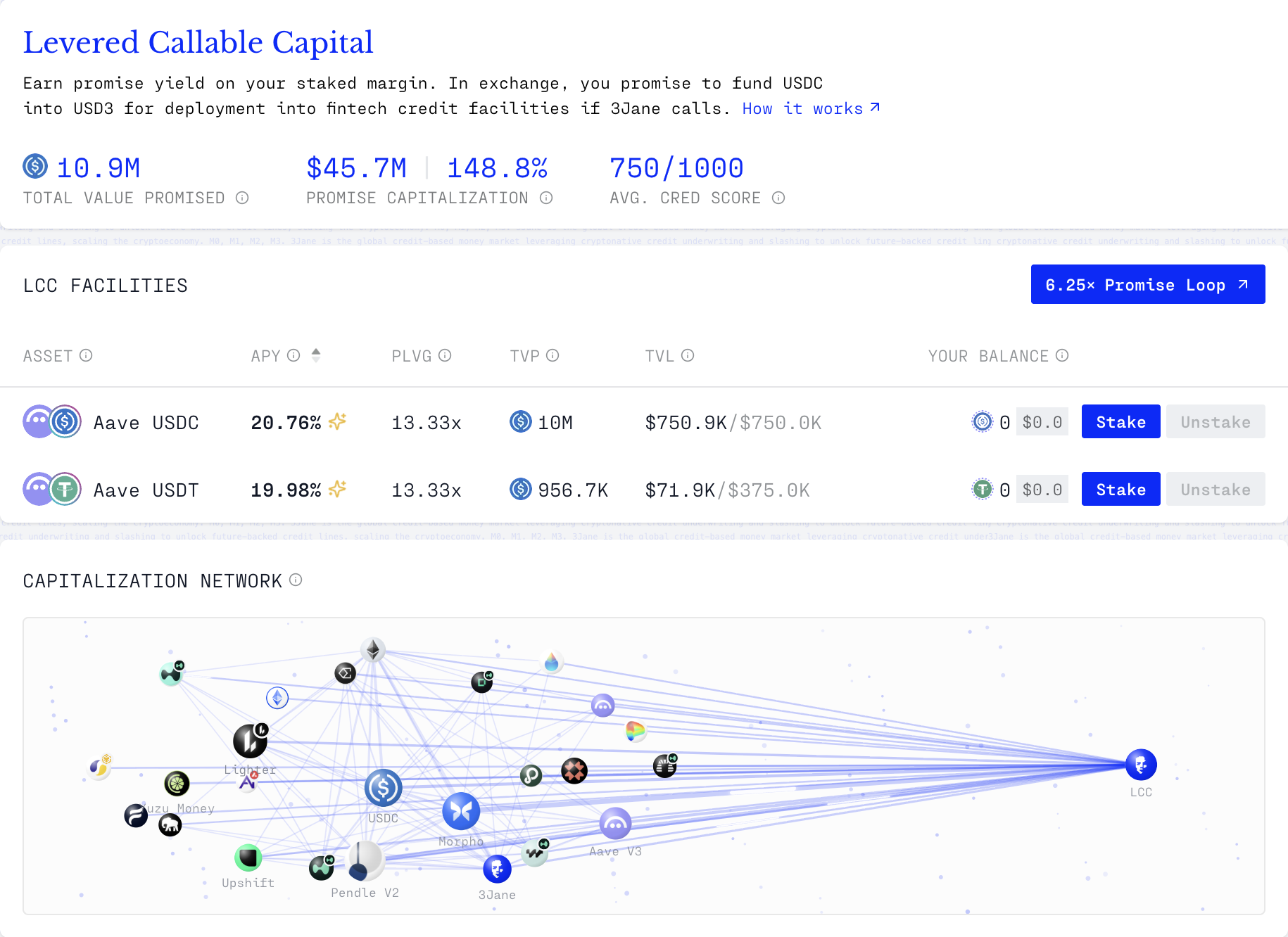
Seven weeks after launch, stakers have promised $10.9M across two facilities, Aave USDC and Aave USDT, at 13.33x promise leverage and roughly 20% APY on margin. Behind those promises sit $45.7M of tracked DeFi assets. Half of all promised dollars come from stakers whose tracked DeFi assets are worth at least 148.8% of what they've promised, and the average staker's Cred Score is 750.
The capitalization network maps where that capital sits today, across Aave, Morpho, Pendle, Lighter, Upshift and a long tail of other venues, each one a balance sheet a staker can draw on when 3Jane calls.
Credit scores can reach every active address
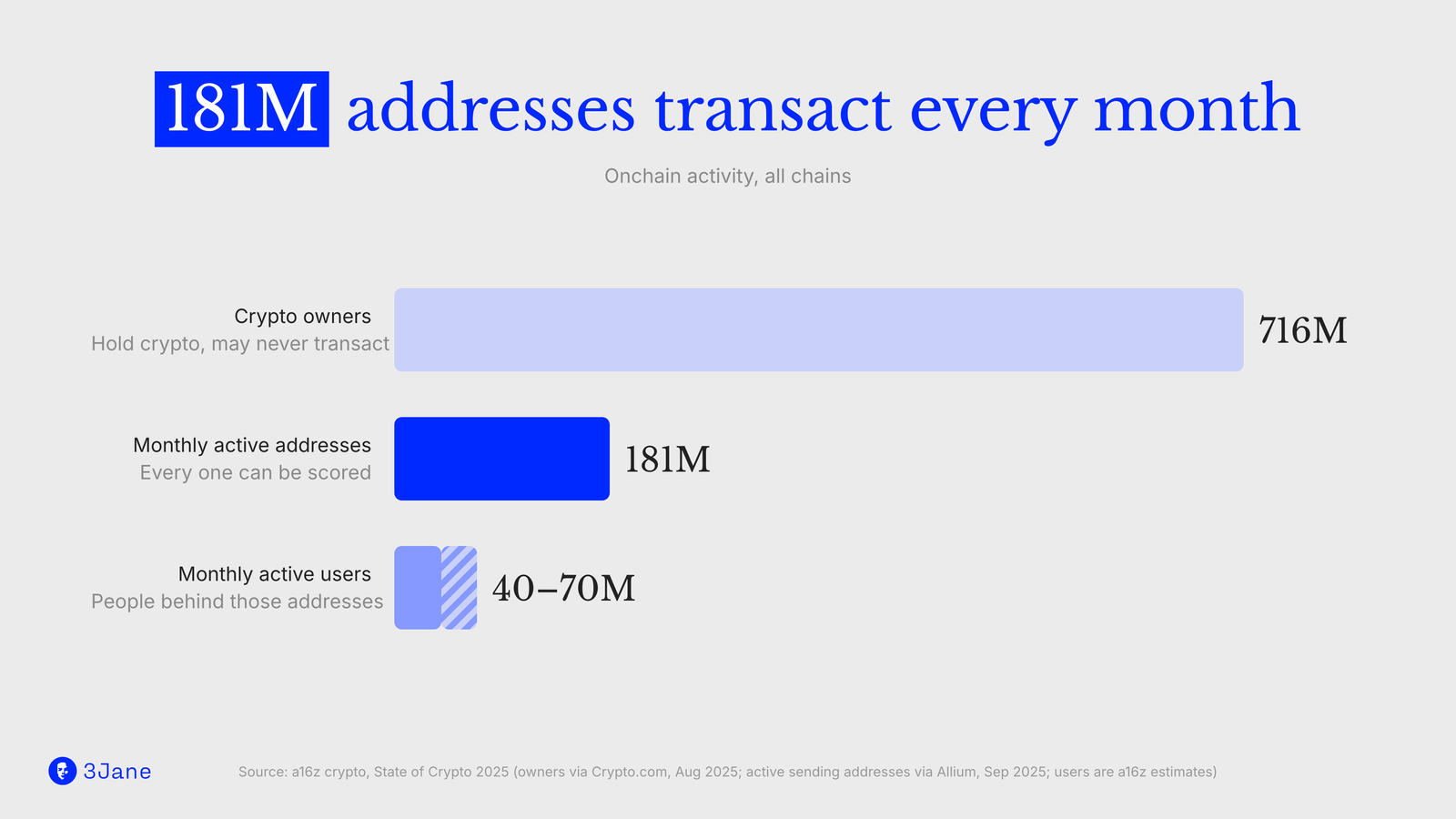
About 181M addresses transact onchain every month, and every one of them can be scored permissionlessly. That includes far more than retail wallets. Pseudonymous credit funds, liquid funds and trading desks all operate through addresses too, and in principle the same approach can price the counterparty risk of any entity that transacts onchain.
Conclusion
Early on, DeFi made a deal with the devil by replacing trust with collateral. It was the right trade at the time. Lending became trustless, settlement became atomic, and crypto assets could be put to work without anyone needing to know who was on the other side. The cost was capital efficiency, and with it most of the world's balance sheets, which never had a way in.
Credit scores, applied to promises rather than loans, let DeFi reopen that trade. LCC promises are heavily undercollateralized, with $7.50 of margin behind every $100 promised, and a promise can still go unfunded. Margin and auctions price that risk and give someone else a reason to step in, while creditworthiness decides how much each address can promise and on what terms. Every funded call adds to the record behind it.
In traditional finance, it took more than a century of credit bureaus, courts and collectors for credit scores to reach a few hundred million people. Onchain, a score can reach every active address immediately and permissionlessly. Once creditworthiness can be posted as collateral alongside BTC, ETH and stablecoins, DeFi can draw on capital held well beyond its own contracts, including the capital that funds, institutions and individuals keep outside DeFi today.
Banks alone carry more than $10T of unused loan commitments, a market built entirely on the credibility of whoever makes the promise. With credit scores, that market can be rebuilt onchain and opened to every address.
That is what we are building toward at 3Jane, starting with the promises behind our own facilities.


